
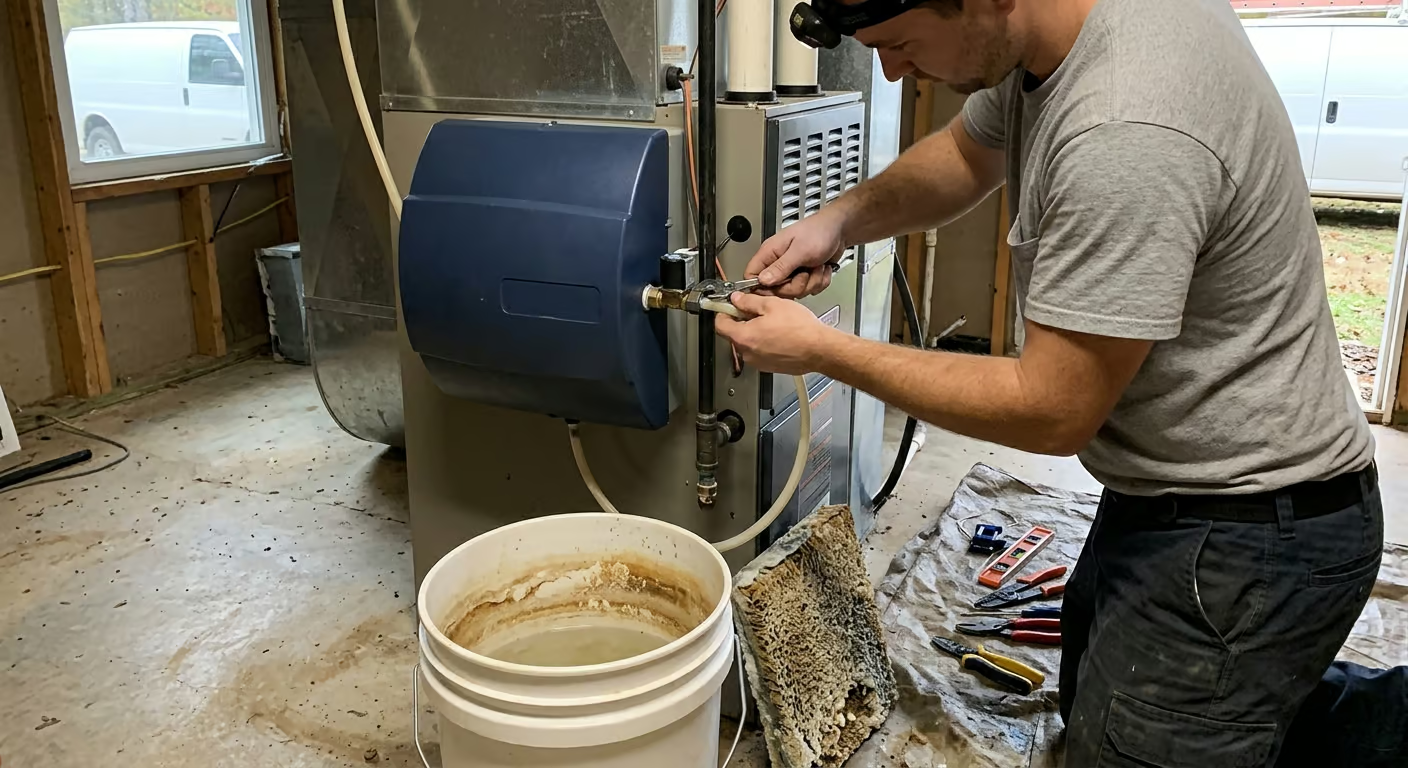
You’ve seen the white residue on your faucets, pulled spotty glasses out of the dishwasher. That’s Halifax County well water leaving its mark, and it does the same thing inside your whole-home humidifier where you can’t see it.
Here’s the value promise up front: well water HVAC humidity in Halifax comes down to minerals. Calcium, magnesium, and iron cake up humidifier parts, clog solenoid valves, and cut equipment life shorter than the manufacturer expects. Those minerals don’t disappear when the water evaporates. They stay behind and pile up on the very parts that make your humidifier work.
This piece covers three things: why this happens on well water, what the damage looks like inside your system, and how to protect the equipment you already paid for.
The Short Answer: Does Well Water Damage a Whole-Home Humidifier?
Yes. Well water damages whole-home humidifiers faster and more severely than city water does.
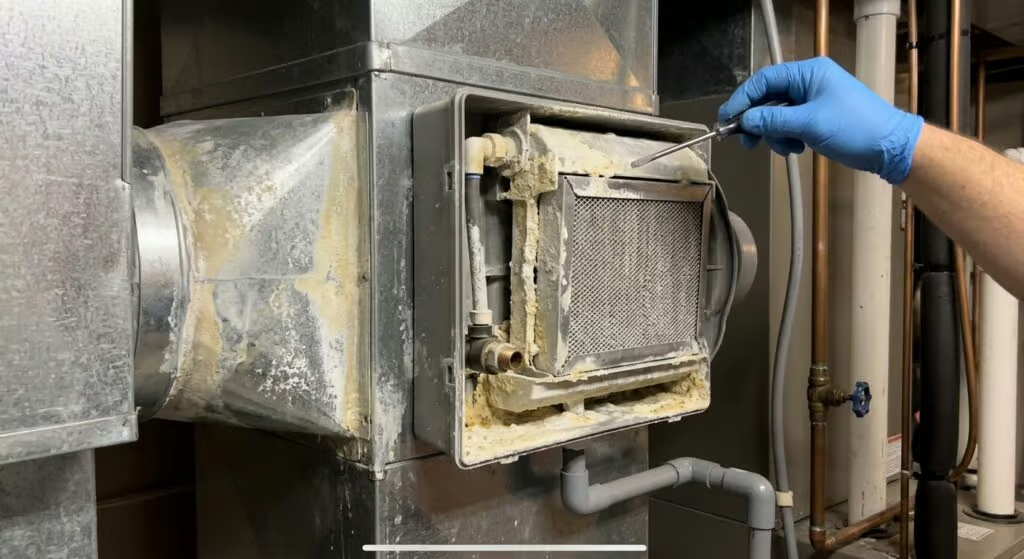
If you’re on a private well in Halifax and your humidifier stopped keeping the house comfortable a year or two after it was installed, the manual didn’t warn you about this. The mechanism is simple. Your humidifier evaporates water to add moisture to your home’s air, and when that water evaporates, the calcium, magnesium, and iron dissolved in it stay behind as solid mineral scale. [1] That scale coats the water panel, the evaporator pad, and the solenoid valve. Over time it chokes water flow and drops humidity output. Eventually parts stick, clog, or fail entirely.
What’s Actually in Halifax County’s Well Water, And Why It Matters for HVAC Equipment
Halifax County sits in Virginia’s Piedmont physiographic province, where homes draw from fractured rock aquifers, water held in the cracks and seams of hard bedrock.
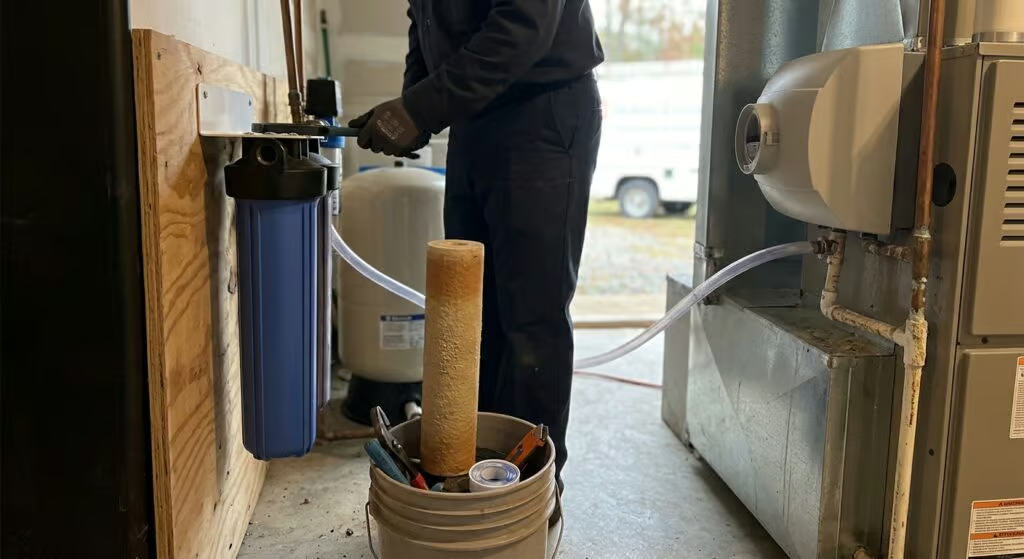
Fractured rock aquifers like these are widely documented by geologists as prone to elevated hardness and iron content, since groundwater picks up minerals as it moves through cracks and seams in bedrock rather than filtering through sand or gravel. Virginia Cooperative Extension’s water testing programs regularly flag hardness and iron as common findings in Piedmont-area wells.
Two separate problems come from this, and homeowners should keep them apart:
The first is hardness. Calcium and magnesium are what make water “hard,” and they form the crusty white scale you see on fixtures and inside equipment. The second is iron and manganese, which cause rust-colored staining and a different kind of clogging. [2] Iron builds up as reddish sludge that can block small valves and passages, not the same thing as calcium scale at all.
A humidifier on Halifax well water often deals with both at once. That combination wears parts faster than either problem alone.
One more point matters here. Private wells aren’t regulated the way public water systems are. Virginia Cooperative Extension is clear that testing and treatment fall entirely on you, the homeowner. Nobody else is checking your water for you.
Have a Question About Your Home?
Talk to a real person on our Halifax team. We'll give you a straight answer and an upfront price.
How Mineral Buildup Shows Up in Your Humidifier and Ductwork
You don’t need tools to spot the early signs. The damage leaves visible clues around your equipment and vents.
Watch for these symptoms:
- White crusty dust on the humidifier unit or drifting around your supply vents.
- Weak humidity output even when the system runs constantly and the setting is high.
- A solenoid valve that sticks, drips, or won’t shut off, which wastes water and can flood the drain.
- Water panels that wear out early, needing replacement well before the seasonal schedule most manufacturers list.
That last one catches people off guard. A manual might say to swap the panel once a season, but on heavy well water, you may need it far sooner.
Now add the older-home factor. Halifax County’s housing stock skews older and rural, and a lot of these homes are still running original or undersized ductwork installed long before whole-home humidifiers were common. That ductwork already struggles to move humidity evenly from room to room. A scaled-up humidifier only makes that worse. It can’t push out the moisture the house needs, so the uneven, dry-in-spots feeling gets stronger. The humidifier didn’t create the duct problem, but mineral buildup piles right on top of it and affects your indoor air quality.
Protecting Your System: Maintenance Homeowners on Well Water Should Actually Follow
Start with what the manufacturer already tells you. Most humidifier makers publish a basic seasonal routine, and it’s a fair baseline for city water.
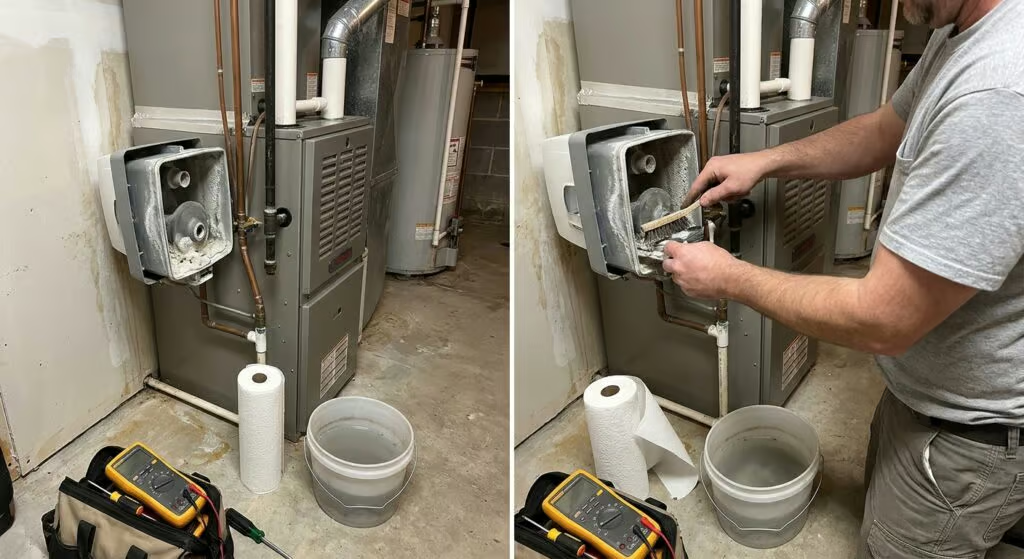
Follow this sequence each season:
- Replace the water panel or evaporator pad at the start of heating season, then check it mid-season.
- Descale the internal parts by soaking them in a vinegar solution to break down mineral crust.
- Flush the drain line so scale and iron sludge don’t back up and cause leaks.
- Inspect the solenoid valve for sticking or slow shutoff, and clean the small inlet screen.
Here’s the honest part: that schedule assumes clean, treated water. Halifax well water with real hardness or iron content needs service more often than the standard calendar suggests.
Many homeowners ask about a water softener next. A whole-house softener or an iron filter can meaningfully extend the life of your humidifier and your ductwork, because it trims the mineral load before water ever reaches the equipment.
But don’t guess at treatment. The right first step is testing your water. A test tells you whether hardness, iron, or both are the real problem, so you fix the actual cause instead of buying the wrong equipment.
One Team, One Visit: Testing Your Water and Servicing Your HVAC System Together
A humidity problem rooted in well water usually forces two phone calls, one to a water treatment company, one to an HVAC company. Each blames the other, and you’re stuck in the middle.
Solutions Heating & Cooling handles both sides under one roof. Our capability spans HVAC, plumbing, and water-related service lines, so one team can trace a scale or humidity issue back to its water-quality source.
That means a single technician can look at the whole picture. We check the humidifier, inspect the ductwork, and factor in what your well water is actually doing to the equipment. We treat the root cause, not just the symptom you noticed at the vent.
We’ve worked from our Halifax Road base since 2015, serving homeowners across Halifax and Southside Virginia, so we know how Piedmont well water behaves in local homes.
When to Call: Signs Your Well Water Is Already Affecting Your HVAC System
If your humidifier pads are crusting over, your system is running harder than it should, or your air still feels dry after every fix, that’s the point to have someone check both sides at once. Contact us to schedule a system evaluation, or call us at Solutions Heating & Cooling at (434) 404-4461 and we’ll tell you what your water is doing to your HVAC before recommending anything.
Well Water and Humidifiers: Your Questions Answered
How often should I change my humidifier pad if I have well water?
Homeowners on well water should change their humidifier pad more often than the manual says. Most makers list once per heating season for clean water, but on Halifax well water with hardness or iron, you may need a new pad mid-season or sooner. Check it monthly and swap it when scale chokes water flow.
Do I need a water softener for my HVAC humidifier?
A water softener may help your HVAC humidifier, but test your water first. A softener or iron filter can cut mineral load and stretch humidifier life. Even so, you should know whether hardness, iron, or both is the real problem, so you don’t buy the wrong equipment.
Why does my humidifier leave white dust or crust around vents?
White dust or crust around your vents comes from dissolved minerals in well water. When your humidifier evaporates that water, the calcium and magnesium stay behind as solid scale, and some of that mineral dust drifts into your ductwork and settles around supply vents. It’s a sign your water is hard.
Sources
- pmc.ncbi.nlm.nih.gov/articles/PMC7408721
- extension.psu.edu/iron-and-manganese-in-private-water-systems
Hard well water shouldn’t wear out your humidifier before its time.
One visit covers both the equipment and the water feeding it, so you’re not chasing the same problem twice.
Call (434) 404-4461 →