

You have a duct leakage report in one hand and a quote in the other. The page is full of CFM25 readings, percentages and a promised drop after sealing, and heating season in South Hill is close. What you really want to know is simple: will the money come back on your bill?
The aeroseal duct sealing cost only means something next to what your own test shows. According to the U.S. Census Bureau, the median home in South Hill was built in 1980, and plenty of homes from that era have ducts running through crawl spaces and attics, so leakage numbers vary widely from house to house.
Below, we’ll walk through reading the report, comparing before and after results, and judging whether sealing pays off for your home. It’s the talk we’d have at your kitchen table, just written down.
When Aeroseal Duct Sealing Pays off for a South Hill Home
Pull out your leakage report and check two things: the leakage reading and where the leaking ducts run. Aeroseal duct sealing is most worth the cost when that reading is high and the leaking ducts pass through space you don’t heat, like the crawl space under a South Hill home or the attic above it. Heated air escapes before it reaches your rooms, and you pay to replace it every cold night from December through February.
Sealing is least worth it in three cases:
- Your ducts sit inside the heated part of the house, so leaked air still warms your living space.
- Your starting leakage is already low, so the ceiling on savings is small.
- The real problem is something sealing can’t touch, like ducts that are the wrong size or equipment near the end of its life.
What CFM25 Means and Why the 25 Matters
CFM stands for cubic feet per minute. On a leakage test, it’s how much air escapes your ducts each minute.
The 25 is the test pressure: 25 pascals. [1] To get there, the technician covers the registers and grilles, connects a calibrated fan to the duct system, and holds the ducts at that pressure. Identical conditions every time let before and after tests be compared side by side.
Reports usually list it as “CFM25 total” or “CFM25 to outside.” If a number has no pressure attached, ask how it was measured; a reading taken at a different pressure won’t line up with a CFM25 number.
Total Leakage vs. Leakage to Outside, and What the Percentage Is Measured Against
Your report may show two leakage readings. Total leakage counts air escaping from every duct gap, wherever it goes. Leakage to outside counts only air lost outdoors or into unheated spaces like a vented crawl space or attic.
For your heating bill, that second number matters most. Air that leaks into a heated room isn’t wasted.
Percentages may compare leakage to the system’s fan airflow or to the home’s floor area. A result on one basis tells you nothing about a target set on the other.
Ask the tester three things:
- Is this total leakage or leakage to outside?
- Is the percentage based on fan airflow or floor area?
- Was the air handler included in the test?
Have a Question About Your Home?
Talk to a real person on our South Hill team. We'll give you a straight answer and an upfront price.
Comparing Before and After Numbers on the Same Basis
You may see a promise of a 90 percent or greater cut in leakage. That figure means little without the starting point.
Here’s an illustrative example, not real customer data. House A tests at 400 CFM25 to outside and drops to 40 after sealing. That’s a 90 percent cut, with 360 CFM25 of leakage gone. House B starts at 80 and drops to 8. Same 90 percent, but only 72 CFM25 recovered.
House A has five times as much to gain.
The two tests also have to match. Put a before number for total leakage next to an after number for leakage to outside, and the drop looks bigger than it is. Switching between airflow and floor-area percentages distorts the result the same way.
Get both readings in writing, with the test type and basis listed on each.
Will the Savings Cover the Cost Over Winter?
Where your ducts run makes the biggest difference. Field research from Lawrence Berkeley National Laboratory and the U.S. Department of Energy found savings of around 10 percent for ducts in basements and roughly 15 to 20 percent for ducts in attics or crawl spaces. [2] ENERGY STAR says sealing and insulating ducts can improve a system’s efficiency by as much as 20 percent. [3]
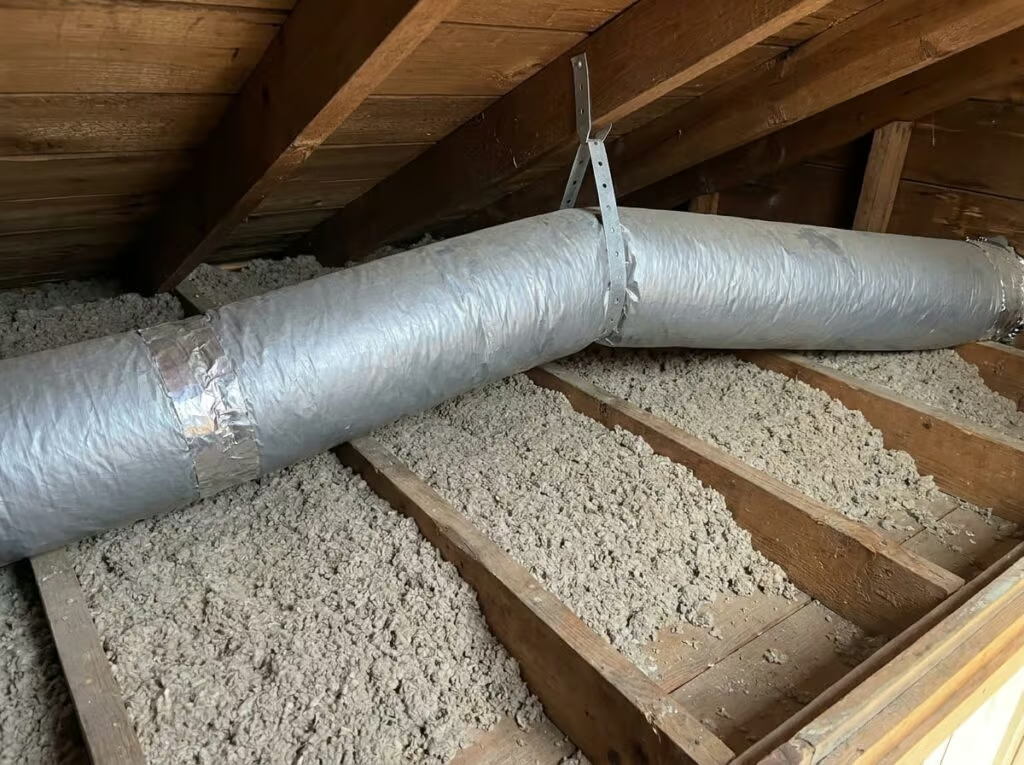
That favors older South Hill homes with ducts under the floor or overhead, and the heating season here is long: NOAA’s 1991-2020 climate normals put the South Hill area at about 3,504 heating degree days a year.
For a rough payback estimate:
- Total your heating costs from last winter’s bills.
- Multiply by the savings range for where your ducts run.
- Divide your quote by that figure to estimate the years to break even.
Why Quotes Differ and What to Ask When Comparing Them
Cost guides published online put Aeroseal anywhere from roughly $1,300 to $6,600. Those are national figures, not South Hill prices, and they reflect rates at the time of writing, so they may have changed since.
What moves a quote up or down:
- Home size and total length of ductwork
- How easy the ducts are to reach, especially in a tight crawl space
- How many registers and grilles need covering
- Which tests are run, before and after
- Warranty length and whether a written report is included
Some households may pay nothing. Dominion Energy lists South Hill among the communities it serves, and its income- and age-qualifying program offers a no-cost home energy assessment with duct sealing among the possible improvements. Its EnergyShare program can provide free air and duct sealing for eligible customers who’ve received bill payment help.
On the co-op side, Mecklenburg Electric Cooperative points income-qualified members to the Weatherization Assistance Program, where an audit is followed by no-cost work such as sealing air leaks. Confirm which utility serves your address before applying.
When Sealing Is Not the Answer
If your ductwork stays within heated space, or your leakage to outside is already low, there’s little lost heat to win back.
Sealing also won’t fix ducts that are too small or too large for the system. It closes leaks; it doesn’t change how much air a duct can carry. If your furnace or heat pump is near the end of its life, settle replacement and duct design questions before sealing.
Get Your Leakage Numbers Checked Before the Cold Sets In
If you already have a leakage report or an Aeroseal quote, bring it to us. We’ll go through the readings line by line and tell you plainly whether sealing makes sense for your South Hill home, or whether your money belongs somewhere else.
No numbers yet? We can test your ducts now, before the first big winter heating bill shows you what the leaks are costing. Contact Solutions Heating & Cooling for exact pricing on Aeroseal for your home.
Leaky ducts heat your attic and crawl space before they heat your rooms. Talk with our South Hill team today: Call (434) 404-5300 →
Aeroseal Questions South Hill Homeowners Ask Before Signing a Quote
How much does Aeroseal duct sealing cost for a typical home?
For a typical home, Aeroseal duct sealing costs roughly $1,300 to $6,600, according to national cost guides. Duct length, crawl space access and the tests included all shape the price. Those figures reflect rates at the time of writing and may have changed since. Contact Solutions Heating & Cooling for exact pricing on your South Hill home.
What percentage of duct leakage is considered acceptable?
In new homes, acceptable duct leakage is usually capped at 4 CFM25 per 100 square feet of floor area. That limit comes from the International Energy Conservation Code, and older homes often test well above it. If your report shows a percentage, check whether it’s based on floor area or fan airflow before you compare.
What does Aeroseal do?
Aeroseal seals duct leaks from the inside by blowing a fine sealant mist through the pressurized duct system. Escaping air carries the particles to each gap, where they stick and build up until the hole closes. Because the leaking air does the work, the sealant reaches gaps hidden behind walls and under floors. Registers are covered first, so it stays inside the ducts.
Sources
- bsesc.energy.gov/problem-sets/duct-leakage-testing-problem-set-12
- energy.gov/sites/prod/files/2015/08/f25/LBNL_Duct_Sealings.pdf
- energystar.gov/saveathome/heating-cooling
Stop Paying to Heat Your Crawl Space
Every winter, the air that escapes your ducts is air you already paid to heat. Call (434) 404-5300 →