
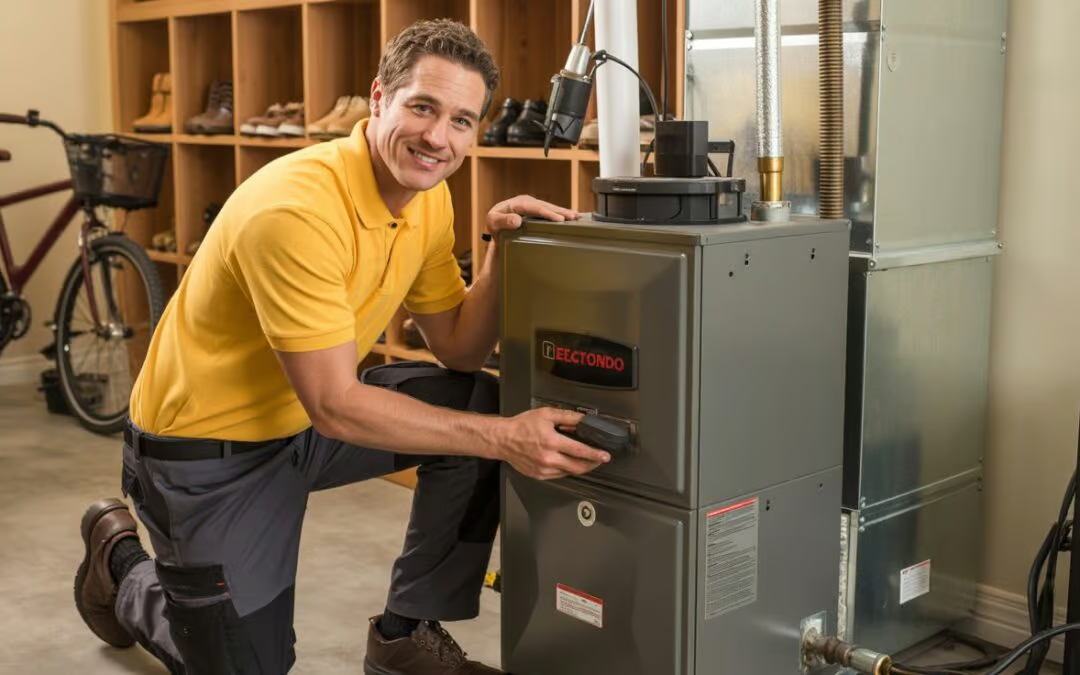
When your furnace starts making strange noises or struggles to keep your Halifax home warm during a cold January night, you face a difficult question: should you repair it or replace it entirely?
For homeowners across Southside Virginia, this decision impacts both your family’s comfort and your budget. A repair might cost a few hundred dollars, while a full replacement can run several thousand. Making the wrong choice could mean throwing money at an old system that fails again next month, or replacing a furnace that had years of life left.
The answer depends on several factors: your furnace’s age, the repair cost, energy efficiency, and how well it’s handling our region’s winter demands. Understanding these signs helps you make a confident decision that protects your home investment and keeps your family comfortable through cold Virginia winters.
This furnace replacement vs repair Halifax VA guide walks you through the specific indicators that point toward repair versus replacement, giving you the knowledge to have an informed conversation with your HVAC professional.
Should I Fix My Furnace or Replace It?
The decision to repair or replace your furnace depends on four key factors:
Repair your furnace if:
- It’s less than 15 years old
- The repair costs less than 50% of a new system
- It’s your first major repair in several years
- Your energy bills remain stable
- The system still heats your home evenly
Replace your furnace if:
- It’s 15-20 years old or older
- Repair costs exceed 50% of replacement cost
- You’ve needed multiple repairs in the past two years
- Your energy bills have increased significantly
- Some rooms stay cold while others overheat
For Halifax homeowners, age and repair frequency are the strongest indicators. A 10-year-old furnace with a $400 repair is worth fixing. An 18-year-old furnace needing a $1,200 repair should likely be replaced, especially before winter hits Southside Virginia.
The Age Factor: How Old Is Too Old for Your Furnace?
Your furnace’s age tells you a lot about what decision makes sense. Most furnaces last between 15 and 20 years with proper maintenance. After that, you’re living on borrowed time. Recognizing aging furnace signs early helps you plan before emergency strikes.
Think of it like a car. A 10-year-old vehicle with one issue? You fix it. A 20-year-old car that needs a major repair? You start shopping for something new.
The “sweet spot” for furnaces runs from about 8 to 12 years old. During these years, your system runs efficiently and reliably. You’ve gotten past the break-in period, and you haven’t hit the decline yet. Once a furnace passes 15 years, efficiency starts dropping. Parts wear out faster. The system works harder to produce the same heat. In Southside Virginia, where we get freezing temperatures and ice storms, that extra strain adds up quickly.
Here’s what happens: a furnace manufactured in 2005 or 2010 simply can’t compete with what’s available today. Manufacturing improvements mean modern systems heat more effectively, use less energy, and handle our humid Virginia climate better.
Warranties matter too. Most furnace warranties expire after 10 to 15 years. Once you’re outside that window, every repair comes out of your pocket. A heat exchanger replacement on an 18-year-old system? You’re paying $1,200 to $1,800 for a furnace that might last two more years.
We see this pattern regularly in rural Virginia homes. A furnace installed in 2008 might have served well, but by 2024, it’s past its prime. The question isn’t whether it will fail—it’s when. Understanding your furnace’s age is just one piece of the puzzle. The actual repair cost compared to replacement cost often makes the decision clear.
Calculate the True Cost: The 50% Rule Explained
The 50% rule gives you a simple way to make this decision: if your repair costs more than 50% of what a new furnace would cost, replace it instead.
Here’s how this plays out for Halifax homeowners. A heat exchanger repair runs $1,200 to $1,800. A new furnace installation costs $3,500 to $6,000 depending on your home’s size and the system you choose.
Let’s say your repair quote comes in at $1,400, and a new furnace would cost $4,000. That repair is 35% of replacement cost—you’re still in repair territory. But if that same $1,400 repair is on a furnace that’s 17 years old and already needed a $600 blower motor last year, the math changes.
The hidden cost of repeated repairs catches people off guard. You fix the heat exchanger in November. The ignitor fails in January. The blower motor goes out in February. Each repair seems reasonable on its own, but together they exceed what replacement would have cost.
Energy costs tell another part of the story. An older furnace might cost you $150 per month during winter. A new high-efficiency system could drop that to $95 per month. Over five months of heating season, that’s $275 in annual savings.
Breaking Down Replacement vs. Repair Costs
Common repairs in Southside Virginia range from $200 for a thermostat issue to $1,800 for a heat exchanger. Blower motors run $400 to $700. Ignitors cost $150 to $300.
Replacement costs depend on your system type and home size. A basic furnace for a 1,500 square foot home might cost $3,500 installed. A high-efficiency system for a 2,500 square foot home could run $5,500 to $6,000.
Many HVAC companies offer financing options that spread the cost over 36 to 60 months.
Beyond the numbers, your furnace may be showing physical signs that it’s reaching the end of its useful life. At Solutions Heating and Cooling, we’ve guided hundreds of Southside Virginia homeowners through this exact decision since September 2015. Our approach is straightforward: we assess your specific situation, show you the numbers, explain your financing options, and help you make the choice that’s right for your home and budget.
Furnace Replacement Signs: Warning Signs Your Furnace Is Failing
Your furnace talks to you before it dies. You just need to know what to listen for.
Sounds That Signal Serious Problems
- Banging, clanging, or scraping noises mean something’s loose or broken inside. A banging sound often points to a cracked heat exchanger or delayed ignition. Scraping suggests a blower motor bearing that’s wearing out.
- Constant cycling—when your furnace turns on and off every few minutes—means the system can’t maintain temperature efficiently. Short cycling wastes energy and wears out components faster.
- Strange sounds don’t always mean immediate failure. A rattling panel might just need tightening. But a loud boom at startup or grinding metal-on-metal? Those require professional attention right away.
Uneven Heating Throughout Your Home
Cold bedrooms while your living room feels like a sauna? That’s a classic sign of a furnace losing capacity.
Aging furnaces struggle to distribute heat evenly. The system might heat adequately near the furnace but fail to push warm air to distant rooms. In multi-story Virginia homes, upstairs rooms stay cold while the main floor overheats.
Sometimes this points to ductwork issues. But if your ducts worked fine for years and heating suddenly becomes uneven, your furnace likely can’t generate enough pressure anymore.
Rising Energy Bills Without Explanation
Pull out your heating bills from the past three winters. Compare January to January, February to February. If your bills jumped 20% or more without rate increases, your furnace efficiency is dropping.
Furnaces lose about 15% efficiency after 15 years. A system that started at 80% AFUE might only run at 68% by year 18. Modern systems operate at 90% to 98% AFUE, cutting heating costs by 25% or more.
Yellow Pilot Light or Burner Flame
Your furnace flame should burn blue. A yellow or orange flame indicates incomplete combustion, which can produce carbon monoxide. [1]
If you see a yellow flame, call for professional inspection immediately. Carbon monoxide is odorless and dangerous. Safety comes before budget concerns. This always requires a technician to test and determine if the system can be repaired safely.
Our technicians see these patterns regularly across Halifax and surrounding areas. We’d rather help you repair a system that has years of life remaining than sell you an unnecessary replacement.
If you’re experiencing any of these warning signs, the pattern of how often you’re calling for repairs matters just as much as the symptoms themselves.
How Frequent Repairs Add Up
Once an aging furnace starts breaking down, repairs come faster and faster.
You call for a repair in October. Then December brings another problem. By February, you’re on the phone again. Each repair costs $300 to $600, and suddenly you’ve spent $1,800 in six months.
If you’ve had two or more repairs in the past two years, replacement makes more financial sense than continuing to patch an aging system.
Here’s the common sequence: first the ignitor fails. Six months later, the blower motor struggles. A year after that, the heat exchanger cracks.
Furnaces often fail right at the start of winter. That first cold snap in November hits, the system works harder, and something breaks.
Track your repair history. If you see repairs accelerating, that’s your signal.
Even if repair costs seem manageable, older furnaces cost you money every month through reduced energy efficiency.
Energy Efficiency: Old vs. New Technology
The efficiency gap between old and new furnaces directly affects your wallet every single month.
Understanding AFUE Ratings
AFUE measures how much fuel your furnace converts to heat. An 80% AFUE furnace turns 80 cents of every dollar spent on gas into heat. The other 20 cents goes up the chimney.
Older furnaces built before 2010 typically run at 70% to 80% AFUE. According to the U.S. Department of Energy, a high-efficiency heating system has an AFUE rating of 90% to 98.5%. [2]
For a typical Halifax home, that difference means real money. An old 75% efficient furnace costing $150 per month to run gets replaced by a 95% efficient model that costs $95 per month. That’s $275 saved every winter, or $4,125 over the furnace’s 15-year lifespan.
Smart Thermostat Compatibility
Older furnaces can’t talk to modern thermostats. They lack the wiring and control boards that programmable and smart thermostats need.
New furnaces work seamlessly with WiFi-enabled thermostats. You can adjust temperature from your phone, set schedules around your work hours, and track energy usage in real time.
For busy homeowners, this means lowering the temperature while you’re at work and having the house warm when you get home. No more heating an empty house all day.
Environmental and Comfort Benefits
Modern systems don’t just save energy—they heat better. For example, Energy Star certified furnaces can be up to 15 percent more energy efficient than baseline models. [3]
You get more consistent temperatures room to room. No more cold spots in the bedroom while the living room overheats. New furnaces distribute air more evenly throughout your home.
They run quieter too. That old furnace rumbling in the basement gets replaced by a system you barely hear.
Better humidity control keeps your home comfortable without that dry winter air feeling. Some systems integrate with air quality equipment, giving you cleaner air along with better heating.
Special Considerations for Southside Virginia Homes
Rural Virginia homes come with heating challenges that cookie-cutter solutions don’t address.
- Larger square footage in older construction means your furnace works harder. A 2,500 square foot farmhouse with original windows loses heat faster than a newer home.
- Crawl spaces and basements in our area deal with humidity year-round. That moisture affects furnace lifespan and performance.
- Power outages during winter storms happen here. Ice storms knock out electricity right when you need heat most.
- Propane versus natural gas availability varies across Halifax and surrounding areas. Some homes don’t have natural gas lines, so your furnace options differ.
- Historic homes present their own challenges. High ceilings and older construction require furnaces sized differently than standard homes.
Having worked exclusively in rural Virginia since 2015, we understand challenges that national companies often miss—from crawl space moisture to propane system nuances to the specific demands of heating older, larger homes common in our area.
With all these factors in mind, here’s how to move forward with confidence.
Making the Decision: Your Next Steps
Don’t wait until your furnace dies on the coldest night of winter. If you’re seeing warning signs, get that assessment done now while you have time to make a careful decision. Whether you’re weighing furnace replacement vs repair Halifax VA options or need immediate help, Solutions Heating and Cooling provides the honest guidance Halifax homeowners deserve.
- Phone: (434) 404-4461
- Location: 5037 Halifax Road Suite 14, Halifax, VA 24558
- Service Areas: Halifax, Danville, Clarksville, South Boston, and Southside Virginia
Your Most Common Replacement vs Repair Questions
When does furnace repair make more sense than buying a new system?
We recommend repairing your furnace when it’s less than 15 years old, the repair costs less than 50% of a new system, and you haven’t needed multiple repairs recently. If your system still heats evenly and your energy bills remain stable, repair is the smart choice. Once furnaces pass 15-20 years old or require frequent repairs, replacement becomes more cost-effective.
What are the warning signs that your heating system needs replacement?
We see several clear warning signs that indicate replacement is needed: banging or scraping noises from the unit, constant on-off cycling, uneven heating between rooms, energy bills that have jumped 20% or more, and a yellow pilot light instead of blue. If your furnace is 15-20 years old and showing any of these symptoms, especially if you’ve needed two or more repairs in the past two years, replacement makes financial sense.
Does it make financial sense to replace a furnace after two decades?
Yes, replacing a 20-year-old furnace makes strong financial sense even if it’s still working. Furnaces typically last 15-20 years, and once they pass 15 years, efficiency drops significantly—often losing 15% or more of their original efficiency. A 20-year-old system costs considerably more to operate monthly and is living on borrowed time before major component failures occur.
Resources
- https://www.cpsc.gov/Safety-Education/Safety-Education-Centers/Carbon-Monoxide-Information-Center
- https://www.energy.gov/energysaver/furnaces-and-boilers
- https://www.energystar.gov/products/furnaces