
Your water heater is only eight years old, but it looks like it’s pushing fifteen. Your faucet handles have a white crusty buildup. Your soap barely lathers. Sound familiar? Halifax County homeowners on well water deal with high mineral content more often than not — and the damage adds up quietly. Find out what’s causing it and what you can do about it.
Does Halifax, VA have hard water?
Yes — Halifax County, VA has hard water. Most homes draw from private wells that pull groundwater through mineral-rich rock and soil, picking up calcium and magnesium along the way. That shows up as white scale on fixtures, poor soap lather, and faster wear on water heaters and appliances.
What Causes Hard Water in Halifax County?
Halifax County sits on top of geology that almost guarantees hard water for well owners. Groundwater moves slowly through layers of sedimentary rock — limestone and shale — picking up calcium and magnesium as it goes. By the time it reaches your well, it’s already carrying a significant mineral load.
Municipal water goes through a treatment process that filters some of that out. Well water doesn’t. Whatever the ground contributes comes straight to your tap. That’s why elevated hardness is common in Halifax County — it’s not a fluke or a sign something went wrong with your well. It’s just what the geology here does. Virginia Tech’s Household Water Quality Program has documented this pattern across Southside Virginia, and Halifax County fits the profile. [1]
How Do You Know If You Have Hard Water?
If you’re already seeing the signs around your house, you probably don’t need a test to tell you something’s off. Here’s what hard water in Halifax County actually looks like day to day.
Signs You’ll See Around the House
Most of the visible symptoms show up on surfaces that water touches regularly:
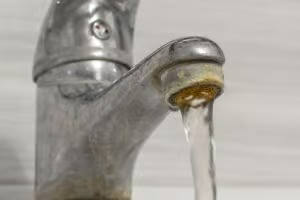
- White or yellowish scale buildup on faucets, showerheads, and fixtures
- Soap that won’t lather well in the shower or sink
- Spots on dishes and glassware after washing
- Dry skin or hair that feels dull after showering
Signs You’ll Find in Your Mechanicals
The less obvious damage is happening inside your appliances — and it’s often worse:
- Water heater running less efficiently or failing earlier than expected
- Visible scale inside kettles or coffee makers
- Washing machine leaving residue on laundry
The stuff you can see on your faucets is frustrating. The stuff building up inside your water heater is what costs you money.
How to Test Your Water for Hardness
Knowing you probably have hard water is one thing. Knowing exactly how hard it is tells you what kind of treatment you actually need. There are three ways to get that answer.
Three Ways to Test for Hard Water
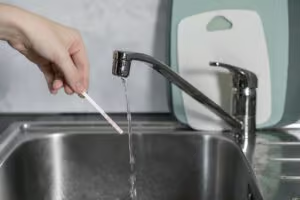
- At-home test strips — Available at most hardware stores. They give you a general hardness reading in grains per gallon. Good starting point, but the precision is limited.
- Virginia Tech’s Household Water Quality Program — Low-cost mail-in testing through Virginia Cooperative Extension. This is the most regionally appropriate option for Halifax County well owners, and the results are reliable.
- Professional water testing — The most accurate option. Solutions Heating & Cooling can assess your water quality directly and recommend treatment based on what your water actually shows.
Not sure where to start? Solutions Heating & Cooling can test your water and tell you exactly what you’re dealing with. Call (434) 404-4461.
What Hard Water Does to Your Home — and How to Fix It
Getting the test done is the easy part. What matters is understanding what happens if you already know you have hard water in Halifax County and don’t do anything about it.
The Long-Term Cost of Ignoring Hard Water
Mineral scale doesn’t cause dramatic, overnight failures. It builds up slowly — and that’s what makes it easy to ignore until something breaks.
Scale accumulates inside your water heater tank, forming a layer between the heating element and the water it’s supposed to heat. The U.S. Department of Energy has noted that scale buildup forces water heaters to work harder and use more energy to reach the same temperature. [2] For homes already running an aging unit, that’s a shorter lifespan on top of a unit that’s already on borrowed time.
It doesn’t stop at the water heater. Hard water reduces efficiency in washing machines and dishwashers over time. Pipes and fixtures develop buildup that restricts flow and accelerates wear. None of it is dramatic on any given day. Over five or ten years, it adds up to real money.
How a Water Softener Solves It
A water softener works through a process called ion exchange — the system swaps calcium and magnesium ions for sodium ions, and what comes out the other side doesn’t leave scale on your fixtures or inside your appliances. Virginia Tech Extension recommends ion exchange softening as the standard treatment for hard well water in this region. Fixtures stay cleaner, soap actually lathers, and your water heater runs the way it’s supposed to.
If you have sodium concerns, salt-free conditioners are an alternative. They reduce scale formation but don’t fully remove hardness minerals — a middle-ground option, not a full replacement for a traditional softener.
Sizing matters either way. An undersized system won’t keep up with your household’s water demand, and an oversized one wastes salt and water during regeneration cycles. Professional sizing and installation is what makes the difference between a system that works and one that doesn’t.

If your fixtures have scale buildup, your soap won’t lather, or your water heater is aging faster than it should — your water is telling you something. Solutions Heating & Cooling has served Halifax County and Southside Virginia homeowners for over a decade, with over a thousand positive Google reviews to back it up. Call (434) 404-4461 to get your water tested and find out exactly what you’re working with.
Solutions Heating & Cooling 5037 Halifax Road Suite 14, Halifax, VA 24558
Hard Water in Halifax County: Your Questions Answered
Is the water in Halifax County, VA considered hard?
Yes, the water in Halifax County, VA is considered hard. Most homes here draw from private wells that pull groundwater through mineral-rich limestone and shale. That groundwater picks up calcium and magnesium along the way, which shows up as white scale on fixtures, poor soap lather, and faster wear on water heaters and appliances.
What are the signs that your home has hard water?
The signs that your home has hard water include white or yellowish scale on faucets and showerheads, soap that won’t lather well, spots on dishes and glassware, and dry skin or dull hair after showering. Inside your appliances, you may notice your water heater running less efficiently or scale building up in kettles and coffee makers.
What’s the best way to check your water’s hardness level?
The best way to check your water’s hardness level depends on how precise you need to be. At-home test strips give a general reading. Virginia Tech’s Household Water Quality Program offers low-cost mail-in testing well-suited for Halifax County well owners. For the most accurate results, we can test your water directly — call us at (434) 404-4461.
Resources
- https://ext.vt.edu/food-health/home-water-quality.html
- https://www.energy.gov/energysaver/water-heating