

If you've lived through an ice storm here, you already know the drill. The lights go out, and you wait. Sometimes for hours. Sometimes for days.
Rural power just takes longer to come back. Crews cover more ground, and downed trees on back roads slow everything down. Whether you're on Halifax EMC or Dominion Energy, a long outage out here is more than an inconvenience. If you're on a private well, no power means no water at all. Medical equipment, refrigerated food, and livestock all depend on steady power too.
That's why so many homeowners are looking into whole house generator installation in Halifax VA. Here's what to know before you buy.
The Short Answer: What a Whole-House Generator Install Actually Involves
A whole-home standby generator is what keeps your well pump running and your refrigerator cold when the utility can't give you a restoration time. It's a permanent system fed by propane or natural gas, wired into your home through an automatic transfer switch. When the power goes out, the switch senses it and starts the generator, often restoring power within seconds. [1] You don't touch anything or run outside in a storm.
Three factors decide how your install goes: your electrical panel has to be ready to connect the generator and carry your home's load, the generator needs correct sizing for either your whole house or just your essential circuits, and the price depends on your home, your fuel setup, and whether your panel needs work first. The fastest way to get real answers for your specific home is to have us look at your panel and talk through your priorities.
Call us at (434) 404-4461 and we'll walk you through whether your panel is generator-ready, what size system fits your needs, and what your install would actually involve, no guessing from a generic guide.
Is Your Electrical Panel Actually Ready for a Standby Generator?
Your electrical panel is the first thing a good electrician checks. Home standby generators fall under NEC Article 702 (Optional Standby Systems), which sets the rules for how the generator connects to your home, including the transfer switch and how much load the system has to handle.
Three conditions matter here. Your panel needs available capacity to carry the load, a workable spot to connect the transfer switch, and it has to be in good working order to begin with. Where that switch goes depends on your system. A whole-house switch often installs between your meter and your panel. An essentials-only setup usually feeds a separate subpanel, which can need open breaker space. Your electrician will tell you which one fits your home.
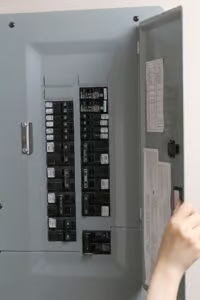
Here's where many Halifax County homes hit a wall. A lot of houses built in the 1970s through the 1990s still run on original 100-amp panels. That was plenty back then. It's often not enough today.
Add up a well pump, an HVAC system, and modern appliances, and a 100-amp panel can fall short fast. In many cases, an upgrade to 200-amp service comes first, before any generator talk begins.
This is the question a qualified electrician should answer during the site visit. Sizing comes second. Generic online guides skip this step entirely, and that's how homeowners get blindsided. We check the panel first, every time.
Sizing It Right: Whole-House Coverage vs. Essential Circuits (Including Your Well Pump)
Sizing starts with one question: do you want to cover the whole house, or just the essentials? NEC Article 220 sets the load calculation rules. Your automatic transfer switch adds one more: the generator has to handle the full load it switches over, unless a load management system controls what runs at once.
Whole-house coverage keeps every circuit running like normal. You'd notice a short pause, then everything comes back on. That takes a larger generator, or a smaller one paired with load management, and usually costs more.

Essential-circuits coverage powers only what you truly need. That typically means:
- Your well pump
- Your refrigerator and freezer
- A sump pump, if you have one
- Your heating and cooling system
- Select lights and outlets
For rural Halifax County homes on private wells, the well pump is non-negotiable. Without it, you have no running water, no toilets, no showers. We treat it as a must-have circuit on every essential-only design.
Skip the rough wattage calculators you find online. They guess, and guessing costs you either way. Undersize the generator, and it shuts down under load right when you need it most. Oversize it, and you pay for capacity you'll never use.
A licensed electrician runs a real load calculation based on your actual home. That number tells you the right size, and it points you toward the coverage option that fits your budget and your needs.
What Installation Typically Costs and Where Halifax County Homeowners Should Expect Variables
National cost guides put most whole-house generator units at $5,000 to $18,000, with a 20 to 24 kW unit running about $5,000 to $6,500 before installation, which typically adds $1,500 to $5,000. [2] These are national figures. They shift by region, home size, fuel line work, and whether your panel needs an upgrade first. Pricing reflects rates at the time of writing and may have changed since publication.
Your fuel choice affects cost too. Propane and natural gas both work well for standby generators, but in Halifax County, availability depends on your property. Many rural parcels don't have natural gas service, so propane becomes the practical option. That may mean a tank and gas line work.
Virginia requires an electrical permit for standby generator installation. Ask your installer whether permitting is folded into the quote. You don't want to find out later that it wasn't.
One quick clarification. If you search online, you'll turn up Dominion's interconnection rules. Those apply to solar and parallel generation, not standby backup generators. A standby generator with an automatic transfer switch never feeds power back to the grid, so those rules don't apply to you.
The only way to get a real number is a site visit. Contact Solutions Heating & Cooling for an exact, site-specific quote.

Getting Started with a Site Visit
Solutions Heating & Cooling serves Halifax County and Southside Virginia. We work across both Halifax EMC and Dominion Energy territory, in town and out on rural roads alike. We're part of an established local HVAC and electrical service provider that folks around here have counted on for years.
A site visit puts everything in one conversation. We check your panel capacity, run the load calculation, talk through propane or natural gas, and handle permitting. No piecemeal guessing.
Ready to look at backup power for your home? Call us at (434) 404-4461 to schedule a site assessment and get your quote.
Common Questions About Whole-Home Generators in Halifax County
Can my electrical panel handle a whole-house generator?
Maybe, but many older Halifax County homes can't. Panels need available capacity, open breaker space, and good working order. A lot of houses built from the 1970s to 1990s still run 100-amp panels, and those often need an upgrade to 200-amp service before a generator install can proceed.
How many watts do I need for a whole-house generator?
It depends on whether you want whole-house or essential-circuits coverage. Whole-house coverage needs a larger unit to run every circuit. Essential coverage powers only your well pump, refrigerator, heating, cooling, and select outlets. A licensed electrician runs a real load calculation to find your correct size.
How much does a whole-house generator cost installed?
National cost guides put most whole-house generator units at $5,000 to $18,000, with installation typically adding $1,500 to $5,000. Your final cost depends on home size, fuel line work, and whether your panel needs an upgrade first. Contact us for an exact, site-specific quote.
Do I need a permit for a standby generator in Virginia?
Yes, Virginia's statewide building code requires a permit for standby generator installation, and Halifax County handles permits and inspections through its Building Code Enforcement Department. Propane or natural gas units also involve fuel line work, which may need its own permit. We handle permitting as part of every install, so it's covered in your quote.
Ready to Get Started?
Ready to keep the lights on through the next storm? Talk to a local electrician about a whole-home generator sized right for your Halifax County home. Call (434) 404-4461 →
Sources
- thisoldhouse.com/electrical/21015441/power-on-demand-how-it-works
- bobvila.com/articles/whole-house-generator-cost