
When the power goes out in rural Halifax, you’re not just losing lights—you’re losing heat, hot water, and access to well water for drinking, cooking, and bathing. Power outages during ice storms can last days in Southside Virginia, making a properly sized backup generator a necessity.
But most homeowners face this challenge: buy too small a generator and it won’t run your well pump and HVAC simultaneously. Buy too large and you’ve overspent by thousands on capacity you’ll never use.
This guide shows you how to calculate your home’s wattage needs, from understanding starting watts versus running watts to sizing for well pumps and heat pump systems. You’ll learn which appliances to prioritize, how to avoid costly undersizing mistakes, and what generator capacity makes sense for Halifax homes. Our licensed electricians help homeowners make these decisions every day—here’s what you need to know.
By the end, you’ll know exactly what size generator your home needs and why.
What size generator do I need to run my whole house?
Most homes typically require a 7,500 to 22,000-watt generator depending on coverage goals to power essential systems during outages. Your specific size depends on what you want to run:
- Essential circuits only (well pump, refrigerator, some lights): 5,000-7,500 watts
- Essential circuits plus HVAC (heat pump or furnace): 10,000-15,000 watts
- Whole-home coverage (all circuits, no priority decisions): 16,000-22,000 watts
Homes with well pumps, electric water heaters, or heat pump systems typically need larger generators than homes on city water with gas heating. The exact wattage depends on your specific appliances’ starting and running requirements.
Understanding Generator Wattage: Starting Watts vs. Running Watts
The biggest mistake homeowners make? Focusing on running watts and ignoring starting watts.
Running watts = continuous power to keep appliances operating (your refrigerator uses 700 watts to maintain temperature)
Starting watts = surge power when motors start up (that same refrigerator needs 2,100 watts for 2-3 seconds when the compressor kicks on)
Motor-driven appliances like well pumps, HVAC systems, and refrigerators often require 2-3 times their running wattage just to start, though some equipment draws even more. Your generator must handle the highest starting wattage demand, not just combined running watts.
Real example: A 3/4 HP well pump needs 1,200 running watts but 3,600 starting watts. Buy a 3,000-watt generator thinking “I only need 1,200 watts for the pump,” and you’re 600 watts short every time it tries to start. Your family has no water.
When your heat pump kicks on while the refrigerator is running, the generator handles that starting surge on top of existing loads. Well pumps and heat pumps create the largest surge loads in rural Virginia homes.
Common Appliances and Their Wattage Requirements
Check your appliance nameplates for exact requirements—look for metal tags with electrical specifications.
| Appliance | Running Watts | Starting Watts | Key Notes |
| Well pump (1/2 HP) | 1,000-1,200 | 3,000-3,600 | Deep wells (200+ ft) draw more |
| Well pump (3/4 HP) | 1,200-1,500 | 3,600-4,500 | Common in Halifax |
| Well pump (1 HP) | 1,500-2,000 | 4,500-6,000 | Deep well systems |
| Heat pump (3-ton) | 3,500-4,500 | 10,000-12,000 | Higher surge in cold weather |
| Heat pump (4-ton) | 4,500-5,500 | 12,000-15,000 | Larger homes |
| Gas furnace | 600-900 | 1,800-2,700 | Blower motor only |
| Electric water heater | 4,000-5,500 | 4,000-5,500 | No surge |
| Refrigerator | 600-800 | 1,800-2,400 | Compressor surge |
| Sump pump | 800-1,200 | 2,400-3,600 | Critical during storms |
Calculating Your Home’s Total Wattage Needs
Here’s the process that actually works for figuring out what size generator you need.
Step one: List every appliance you want to run simultaneously during an outage. Not everything you own—just what needs to operate at the same time.
Step two: Find the running watts and starting watts for each appliance using the table above or checking equipment nameplates.
Step three: Add up all the running watts for everything on your list.
Step four: Identify the single highest starting watt requirement from your list (usually your well pump, heat pump, or central air conditioning).
The formula: Total running watts + highest single starting watt requirement = minimum generator size
You don’t add all starting watts together because appliances don’t all start simultaneously. Your well pump, refrigerator, and furnace blower won’t all kick on at the exact same second. The generator only needs to handle the largest surge plus the running loads already operating.
Creating Your Essential Appliances List
Start with what matters most:
- Life-safety systems: Well pump (no water without power), heating/cooling system, refrigerator/freezer, sump pump
- Communication: Lights, phone chargers, internet router, medical equipment
- Optional comfort items: Electric water heater, electric stove, washer/dryer, window AC units
Every comfort item pushes you toward a larger, more expensive generator. You can live without hot showers and cooked meals for a few days. You can’t live without water.
Sample Wattage Calculation for Rural Virginia Homes
Here’s how this actually breaks down for a typical Halifax home.
Example 1: “Essential Systems Only” (7,500-watt generator)
- Well pump: 1,500 running / 4,500 starting watts
- Refrigerator: 700 running / 2,100 starting watts
- Gas furnace blower: 800 running / 2,400 starting watts
- Lights (LED): 200 running watts
- Total: 3,200 running watts + 4,500 starting (well pump) = 7,700 watts minimum
A 7,500-watt generator handles this load. You’ll have water, heat, food preservation, and lights. No hot water, no internet, no TV—but you’re safe and functional.
Example 2: “Comfortable Living” (12,000-watt generator)
All essential systems above, plus:
- Sump pump: 1,000 running / 3,000 starting watts
- Additional lights: 300 running watts
- TV and internet: 200 running watts
- Microwave: 1,000 running watts
- Total: 5,700 running watts + 4,500 starting (well pump) = 10,200 watts minimum
A 12,000-watt generator gives you everything essential plus enough power to feel normal. You can watch weather updates, work from home if needed, and manage crawlspace moisture. This is the sweet spot for most Halifax families.
Need help sizing your generator? Our licensed electricians assess your well pump, HVAC system, and electrical panel to recommend the right generator size for your Halifax home.
Call Solutions Heating and Cooling: (434) 404-4461

Generator Sizing for Different Home Types in Halifax, VA
Your home’s specific systems make a bigger difference in generator sizing than square footage alone. A 1,800 sq ft home with a heat pump needs a significantly larger generator than the same size home with a gas furnace.
Sizing for Homes with Well Pumps
If you have a well, you need at least a 7,500-watt generator. Smaller generators under 5,000 watts simply can’t provide the 3,000-6,000 starting watts most well pumps require.
Deep well pumps—anything over 200 feet—draw more power than shallow wells because they’re working harder to lift water. A 1 HP submersible pump in a 250-foot well might need 5,000-6,000 starting watts compared to 3,000-4,000 watts for a 1/2 HP pump in a 100-foot well.
Your pressure tank size affects how often the pump cycles. A larger 80-gallon pressure tank means the pump runs less frequently than a 20-gallon tank. This doesn’t change the wattage you need, but it does mean your generator spends less time handling that starting surge.
Well pump failure during a power outage means no drinking water, no toilet flushing, no bathing. You’re hauling water from neighbors or buying bottled water—assuming roads are passable after an ice storm.
Sizing for Homes with Heat Pumps vs. Gas Furnaces
Heat pumps need significantly larger generators than gas furnaces.
A typical 3-ton heat pump requires 10,000-15,000 watts minimum for starting surge. In cold weather below 30°F, that surge can hit 12,000-15,000 watts. The colder it gets, the harder the compressor works and the more power it draws on startup.
Gas furnaces with blower motors need only 2,500-3,500 watts total—the gas provides heat, the generator only powers the blower and controls.
Bottom line: A homeowner with gas heat and well water often gets by with a 10,000-watt generator. Their neighbor with a heat pump needs 15,000-20,000 watts.
Winter heating is life-safety in rural Virginia. Extended outages in 20°F weather cause frozen pipes (thousands in damage) and hypothermia risk for elderly or young family members.
Solutions Heating and Cooling measures your HVAC system’s actual starting amperage during free consultations—we calculate exactly what you need, not guess.
Sizing by Home Square Footage and Electrical Panel Capacity
Here are general sizing guidelines, but remember—your appliances matter more than square footage:
1,200-1,800 sq ft: 10,000-15,000 watts for comfortable coverage with one HVAC system, standard appliances, and well water.
1,800-2,500 sq ft: 15,000-20,000 watts for whole-home coverage. Larger homes often have bigger HVAC systems (4-ton instead of 3-ton) and more circuits.
2,500+ sq ft: 20,000-22,000 watts for comprehensive coverage with multiple HVAC zones and larger electrical loads.
Homes with 100-amp panels rarely need generators over 15,000 watts because the panel itself limits total electrical capacity. Most Halifax homes built before 1990 have 100-amp service. Homes with 200-amp panels and all-electric systems may need 20,000+ watts to run everything comfortably.
Portable vs. Standby Generators: Which Size Makes Sense?
The type of generator you choose affects what sizes are available and how much you’ll spend. Portable and standby generators serve different needs.
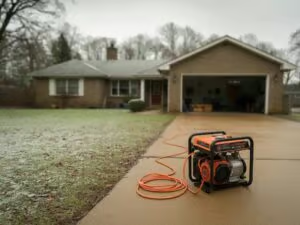
Portable Generators (3,000-10,000 Watts): Best for Essential Circuits
Size range: 3,000-10,000 watts (most homeowners choose 7,000-8,000 watts)
Best for: Budget-conscious families, occasional short outages, essential circuits only
Investment: $800-1,500 for generator + $500-1,000 for transfer switch installation
The tradeoffs:
- Must be home to start generator (no power if you’re traveling)
- Most portable generators run 8-12 hours on a tank of gasoline at moderate loads, meaning you’re refueling daily during multi-day outages.
- Placed outdoors 20+ feet from home (carbon monoxide safety) [1]
- Manual operation and fuel management
Typical Halifax use: A 7,500-watt portable runs well pump, refrigerator, lights, and gas furnace blower—essentials covered, but you’re managing everything manually.
Standby Generators (10,000-22,000 Watts): Automatic Whole-Home Protection
Standby generators are permanently installed units that start automatically within 10-20 seconds of power loss (most modern units start in under 15 seconds) and run until utility power returns. No human intervention required. [2]
They connect to natural gas lines or propane tanks, so there’s no refueling needed. Your generator runs as long as necessary—days or weeks—without anyone adding fuel.
Typical sizing for Halifax homes:
- 10-12kW: Essential circuits plus gas furnace (well pump, refrigerator, heating, lights, some outlets)
- 14-16kW: Most circuits plus heat pump or larger homes—the most popular size for comfortable whole-home coverage
- 18-22kW: Complete whole-home coverage with every outlet, appliance, and light working exactly like normal
Professional installation is required. Licensed electricians handle the automatic transfer switch installation, electrical connections, permits, and inspections. Gas line installation requires licensed plumbers.
The value for rural areas: when ice storms knock out power for 3-5 days in Halifax, automatic operation means your family stays comfortable, your pipes don’t freeze, your food doesn’t spoil, and you don’t stress about generator management. The system protects your home even when you’re away.
The higher upfront investment—$6,000-12,000 for equipment and installation depending on size—pays for hands-off operation during emergencies. For families who travel, have health concerns requiring reliable power, or simply want convenience, that investment makes sense.
Common Generator Sizing Mistakes to Avoid
Most generator sizing mistakes fall into two categories: buying too small and regretting it immediately, or buying too large and wasting thousands on capacity you’ll never use.
Undersizing: The Most Expensive Mistake
Common error: Adding running watts only—”I need 1,500 for well pump + 700 for refrigerator + 800 for furnace = 3,000 watts”—then buying a 3,500-watt generator.
What actually happens: Well pump tries to start, needs 4,500 watts, generator can’t deliver. Breaker trips. No water.
Other undersizing mistakes:
- Forgetting well pump requirements (common with city-to-rural transplants)
- Assuming 7,500 watts handles whole-home needs (rarely true)
- Not accounting for all circuits you want protected
Real consequence: A 5,000-watt generator can’t start 3/4 HP or 1 HP well pumps—common sizes in rural Virginia homes.
Smart approach: Calculate actual needs, add 20% buffer. The $800-1,000 difference between 10kW and 12kW prevents overload and extends equipment life. Better to have capacity you don’t use than need capacity you don’t have.
Oversizing: Wasting Money on Unnecessary Capacity
The opposite mistake: buying a 22kW generator when 14kW would cover all realistic needs. You’ve wasted $2,000-4,000 in unnecessary equipment costs plus higher installation expenses.
Larger generators consume more fuel even at partial load because they’re less efficient when not operating near capacity.
When does oversizing make sense? Planning for future additions like a detached workshop, electric vehicle charger, or room addition. If you know your electrical needs will increase in 2-3 years, buying larger now avoids replacing the generator later.
How to right-size: calculate your actual needs using the method we covered earlier, add a 20% buffer for safety, then stop there. If your calculations show 10,000 watts needed, a 12,000-watt generator makes sense. A 20,000-watt generator doesn’t.
Ignoring Professional Load Calculation
What DIY calculations miss:
- Wire sizes and voltage drop affecting actual capacity
- Circuit breaker ratings limiting safe loads
- Appliance diversity factors (experience-based estimates)
What professionals provide:
- Load calculation software following National Electrical Code [3]
- Measured starting amperage for your specific well pump and HVAC
- Electrical panel capacity assessment
- Identification of panel upgrades needed before generator installation
Why it matters: Undersized generators need replacement ($3,000-6,000 lost). Oversized generators waste $2,000-4,000 upfront. Improper electrical work creates safety hazards costing thousands to fix.

Ready to Size Your Generator Right?
Don’t guess on generator sizing. Our licensed electricians assess your well pump, HVAC system, and electrical panel to calculate the right generator size for your home—not the most expensive one.
We’ve completed over 150 generator installations across Southside Virginia, helping families stay safe during extended outages.
Schedule your consultation: (434) 404-4461
Service Areas: Halifax, South Boston, Clover, Scottsburg, Virgilina, and surrounding Southside Virginia communities
Generator Sizing Questions Halifax Homeowners Ask
What generator capacity works best for a 2,000 square foot home?
A 2,000 square foot home typically needs 15,000-20,000 watts for whole-home coverage. The actual requirement depends on your HVAC system type—homes with heat pumps need larger generators than those with gas furnaces. Proper sizing considers your specific well pump, heating system, and appliances rather than square footage alone.
Can a 7,500-watt generator power an entire home?
A 7,500-watt generator powers essential circuits only—well pump, refrigerator, gas furnace blower, and lights—but not whole-home coverage. You won’t have hot water, internet, or the ability to run multiple appliances simultaneously. Most homes need 10,000-15,000 watts for comfortable living during outages with heat pump systems and all typical appliances operating.
What’s the reason for maintaining generator distance from your home?
Portable generators should be placed outdoors 20+ feet from your home for carbon monoxide safety. Generator exhaust contains deadly carbon monoxide that can seep into homes through windows, doors, and foundation cracks. This distance protects families from carbon monoxide poisoning, which causes dozens of deaths during power outages every year.
Resources
- https://www.cdc.gov/natural-disasters/psa-toolkit/prevent-carbon-monoxide-poisoning.html
- https://www.consumerreports.org/home-garden/generators/buying-guide/
- https://www.nfpa.org/codes-and-standards/nfpa-70-standard-development/70