

When power goes out in rural Halifax and Southside Virginia, it’s more than an inconvenience—your well pump stops, leaving you without water. Your heating system shuts down, risking frozen pipes. Your sump pump stops protecting your crawlspace.
Installing a home generator requires professional electrical integration between your generator and electrical panel. The connection involves transfer switches, proper panel capacity, and often electrical upgrades to handle backup power safely.
This guide explains how generator panel connections work, what electrical integration involves, and what Halifax homeowners need to know about transfer switches, panel requirements, and the installation process for reliable backup power.
How does a generator connect to a home electrical panel?
A generator connects to your home electrical panel through these steps:
- Transfer switch installation – A licensed electrician installs a transfer switch between your main electrical panel and generator
- Utility disconnect – The transfer switch safely disconnects your home from the utility grid when activated
- Generator connection – Power flows from the generator through the transfer switch to your electrical panel
- Load distribution – The transfer switch routes power to selected circuits or your entire home
- Automatic or manual operation – The switch activates automatically during outages or manually when you start the generator
This prevents dangerous backfeeding and ensures code-compliant, safe operation.
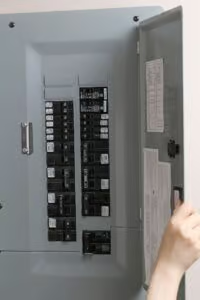
Understanding Transfer Switches and Panel Connection
A transfer switch is a safety device connecting your generator to your electrical panel. [1] It prevents backfeeding—electricity flowing backward into utility lines that can electrocute workers repairing power during outages.
Manual vs. Automatic Transfer Switches
Manual transfer switches cost $400-$800 installed but require you to be home. You flip switches yourself when power goes out.
Automatic transfer switches cost $1,200-$2,500 installed. They detect outages and switch automatically in 30-60 seconds, working even when you’re away.
For Halifax homeowners, automatic switches make more sense. Rural outages last multiple days, and your well pump needs protection whether you’re home or not. Frozen pipes from a dead heating system cost thousands in damage—more than the $800-1,700 difference between manual and automatic.
Electrical Panel Requirements and Upgrades
Many Halifax homes built in the 1970s-1990s have 100-amp panels. Modern generators—especially whole-home systems—need more capacity.
When Panel Upgrades Are Necessary
- No available breaker spaces for transfer switch connection
- Whole-home generator requires 200-amp panel
- Panel is 30+ years old
- Adding other high-demand equipment simultaneously
Panel Upgrade Process
Panel upgrades cost $1,800-$3,500 in Halifax and take 1-2 days. Coordinate with generator installation to save on labor—one trip charge, one permit, one inspection instead of paying twice.
The upgrade includes utility disconnect, panel replacement, circuit transfer, and Halifax County approval.

Whole-Home vs. Critical Circuits Integration
Two approaches affect your electrical requirements and costs.
Whole-Home Generator Systems
Powers your entire panel—all circuits operational during outages. Requires 20-24 kW generator, 200-amp panel, 50-60 amp breaker. Cost: $8,000-$15,000 installed.
Best for medical equipment, work-from-home setups, or complete protection needs.
Critical Circuits Systems
Powers selected circuits only—well pump, heat, refrigerator, lights. Requires 10-14 kW generator, works with 100-amp panels. Cost: $5,000-$9,000 installed.
Best for budget-conscious homeowners prioritizing well water and heat. You’ll lose convenience in some areas, but core systems stay protected.
Need a professional load calculation and panel assessment? Call Solutions Heating and Cooling at (434) 404-4461 for transparent pricing.
Generator Sizing and Load Calculation
Choosing between whole-home and critical circuits directly affects how your electrician calculates the generator size you need. [2]
Professional load calculation prevents undersizing your generator. You can’t just guess based on square footage—you need actual numbers for every major appliance and system.
Typical Halifax Home Loads
Here’s what a 2,000 square foot home typically needs:
Heat pump: 5,000W running, 10,000W starting
Well pump: 1,500W running, 3,500W starting
Water heater: 4,500W
Refrigerator/freezer: 1,500W running, 2,200W starting
Total: 12-18 kW running load
The catch is motor starting surges. When your heat pump or well pump kicks on, they pull 2-3 times their running wattage for a few seconds. That’s why this example home needs a 20-24 kW generator even though the running load is only 12-18 kW.
Professional load calculation costs $150-$300. Your electrician measures actual amp draw for each circuit, calculates starting loads for motors, and sizes the generator correctly. Skip this step and you’ll either buy a generator that’s too small to run your equipment or waste money on one that’s way bigger than you need.

The Installation Process
Here’s what Halifax homeowners should expect:
Pre-installation (Week 1-2): Site evaluation, load calculation, and Halifax County permits
Day 1 (5-7 hours): Panel upgrade if needed, transfer switch installation, and wiring connections. Expect a morning power outage—power returns by afternoon.
Day 2 (4-6 hours): Generator placement, fuel line connection, and final electrical hookup
Testing: Simulated outage test and homeowner training on operation
Inspection: Halifax County approval [3]
Common Integration Challenges in Rural Homes
Rural Halifax homes present specific issues affecting installation costs:
Inadequate grounding in older homes: 1970s-1980s homes often lack proper grounding. Adding grounding rods and bonding costs $200-$600.
Aluminum wiring: Homes from this era may have aluminum wiring requiring special connectors and anti-oxidant compound for safe transfer switch connections.
Distance from panel to generator: If your panel sits opposite your best generator location, expect 50-150 feet of conduit and wire—adding $300-$600 per 50 feet.
Propane vs. natural gas: Natural gas isn’t available in most of rural Halifax. You’ll need a 500-gallon propane tank ($1,500-$2,500 installed) or connection to existing heating propane.

Protecting Your Halifax Home with Professional Generator Integration
Solutions Heating and Cooling has served Halifax, South Boston, Clover, Scottsburg, and Virgilina since 2015. Our licensed electricians handle complete generator integration—panel upgrades, transfer switches, and professional installation.
Ready to protect your well water, heat, and home during the next outage? Call (434) 404-4461
We provide transparent pricing for complete generator integration—no surprises, just reliable backup power when you need it.
Generator and Electrical Panel Connection: Your Questions Answered
Is it possible to wire a generator directly to your home’s electrical system?
Yes, we connect generators to home electrical systems through professional installation. A licensed electrician installs a transfer switch between your main electrical panel and the generator, creating a safe, code-compliant connection that prevents dangerous backfeeding into utility lines while routing backup power to your circuits.
What’s the process for linking a standby generator to residential power?
We install a transfer switch between your electrical panel and generator, which safely disconnects your home from the utility grid during outages. The switch then routes generator power to either your entire panel or selected circuits, operating automatically or manually depending on your system type.
Is professional electrical work required for transfer switch installation?
Yes, licensed electricians must install transfer switches. The work involves electrical panel connections, proper sizing calculations, code compliance, utility coordination, and county inspections—all requiring electrical licensing. DIY installation creates electrocution risks and violates building codes, potentially voiding insurance coverage.
Resources
- https://www.ecmag.com/magazine/articles/article-detail/codes-standards-pass-source-important-aspects-transfer-switches
- https://www.consumerreports.org/home-garden/generators/best-home-standby-generators-consumer-reports-tests-a5942327707/
- https://www.halifaxcountyva.gov/174/Building-Code-Enforcement