
Your water heater is making a noise it’s never made before — or worse, there’s water pooling at the base. You know something is wrong, but you don’t know if it’s a $200 fix or a full replacement. And you definitely don’t know if it’s safe to leave it running overnight.
This guide walks you through exactly what to do in a water heater emergency: how to recognize warning signs that can’t wait, how to safely shut the unit down, and what same-day repair service actually looks like from a plumber who services Halifax County and all of Southside Virginia.
Is a Water Heater an Emergency Repair?
Yes — in several situations, a water heater problem requires same-day attention. Call for emergency repair if you notice any of the following:
- Active leaking from the tank or connections
- No hot water combined with a tripped breaker or pilot light failure
- Rumbling, popping, or banging sounds from inside the tank
- Discolored or foul-smelling water coming from hot taps
- Visible corrosion on the tank, valves, or supply lines
- Water pooling near the base of the unit
If your unit is 10 years or older and showing any of these signs, replacement is likely the safer call. [1]
The Water Heater Problems That Can’t Wait Until Monday
How Urgent Is a Leaking Water Heater?
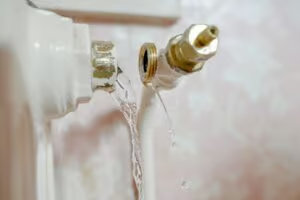
A leaking water heater is urgent — don’t leave it unattended overnight and don’t assume it’ll hold until the weekend.
Where the leak is coming from matters a lot. If water is seeping from the base of the tank, that’s usually a sign of internal corrosion, and it means the tank itself is likely failing. That’s not a patch job. A leak at the pressure relief valve is a different situation — it can point to dangerous pressure buildup inside the unit, which is its own serious problem. Either way, neither one is something you want to monitor and hope for the best.
If you’re seeing water on the floor near your water heater, shut it down and call a plumber the same day.
The Most Common Water Heater Problems
Most water heater failures come down to one of five things:
- Sediment buildup — Over time, minerals from your water supply settle at the bottom of the tank. For homes on well water, this process happens faster than it does on municipal water. That rumbling or popping sound you’re hearing? That’s often sediment burning off. Left alone, it drives up energy costs and shortens the life of the tank.
- Failing heating elements — When you’re getting lukewarm water instead of hot, a heating element is usually the culprit. Electric water heaters have two — if one goes, you’ll notice.
- Corroded anode rod — The anode rod is what keeps your tank from rusting out from the inside. When it wears down completely, the tank starts corroding. Rusty or metallic-smelling water from your hot taps is often the first sign.
- Faulty thermostat — If your water temperature is inconsistent — too hot one day, not hot enough the next — the thermostat is worth looking at.
- Pressure relief valve failure — The PRV is a safety device. If it’s leaking or not functioning, it’s not something to ignore. A stuck or failed PRV can allow dangerous pressure to build inside the tank.
How to Shut Off Your Water Heater Safely in a Crisis
Once you’ve identified the problem, the next priority is getting the unit safely offline until a plumber arrives.
Shutting Off a Gas Water Heater
- Find the gas shutoff valve on the supply line running into the unit. Turn it perpendicular to the pipe — that’s the closed position.
- Turn the thermostat dial on the water heater to “pilot.”
- Shut off the cold water supply valve above the unit.
Don’t attempt to relight the pilot yourself until a plumber has assessed what caused the problem in the first place. If you smell gas at any point during this process, leave the house and call your gas company before anything else.
Shutting Off an Electric Water Heater
- Go to your breaker panel and flip the circuit labeled for the water heater to the off position.
- Shut off the cold water supply valve above the unit.
- Do not drain the tank unless a plumber specifically tells you to.
One thing worth knowing: electric water heaters retain heat and pressure even after the power is cut. Don’t attempt any repairs yourself — the unit being “off” doesn’t mean it’s safe to work on.
When to Shut Off Your Main Water Supply Instead
If you can’t identify where the leak is coming from, or water is actively spreading, shutting off your home’s main water supply is the safer move. Your main shutoff is typically located where the water line enters the house — near the foundation, in a utility room, or in a crawl space.
Unit is off — now it’s time to get a plumber on the way. Call Solutions Heating & Cooling at (434) 404-4461 for same-day service in Halifax County and across Southside Virginia.
What Same-Day Repair Service Actually Covers
Who Should I Call If My Water Heater Isn’t Working?
For water heater work, you want a licensed plumber — someone with dedicated plumbing training, not a general handyman. Solutions Heating & Cooling has a dedicated plumbing division, so you’re getting a plumber who handles this work every day. That matters even more for homes on well water, where the job isn’t straightforward.
Here’s why that matters: well water carries higher mineral content than municipal water, and that accelerates wear on your tank differently than city water does. Sediment builds up faster. Anode rods deplete sooner. A plumber who’s only worked city water jobs may not account for any of that.
Our team at Solutions Heating & Cooling has been serving Halifax County and Southside Virginia for over a decade. We know well water. We know these homes. And when you call us for an emergency water heater repair, you’re not getting someone who’s going to figure it out as they go.
Repair vs. Replacement — How a Plumber Decides on the Spot
When a plumber shows up for a same-day call, they’re weighing three things:
- Unit age — The general threshold is 10 to 12 years. [2] A unit on the younger side of that range with isolated damage is usually worth repairing. One that’s pushing 15 years with multiple issues is a different conversation.
- Extent of the damage — A failed heating element or a worn thermostat is a straightforward repair. Internal corrosion or a compromised tank is not. [3]
- Parts availability — If the part your unit needs isn’t readily available for that model, repair timelines stretch out and the math on replacement starts to shift.
An honest assessment means sometimes the answer really is a repair — not a push toward a full replacement you don’t need. That’s how we operate. We’re not going to recommend a new tank just because it’s easier for us.

Don’t Go Another Night Without Hot Water
Hot water is one of those things you don’t think about until it’s gone — and once it is, every hour counts. Whether it turns out to be a repair or a replacement, you deserve a straight answer from someone who’s actually looked at the unit — not a guess over the phone.
Our team serves Halifax County and all of Southside Virginia, and we’re available for same-day water heater service when you need it. Give us a call at (434) 404-4461.
Solutions Heating & Cooling 5037 Halifax Road Suite 14, Halifax, VA 24558 (434) 404-4461
Water Heater Emergency: Your Questions Answered
Does a broken water heater count as a plumbing emergency?
A water heater absolutely qualifies as a plumbing emergency in several situations. If you’re seeing active leaks, water pooling at the base, discolored or foul-smelling water, unusual sounds from the tank, or visible corrosion — those are same-day calls. Units 10 years or older showing any of these signs are especially urgent, since replacement is often the safer option at that point.
Can a leaking water heater wait, or does it need same-day attention?
A leaking water heater needs same-day attention — don’t leave it overnight or assume it’ll hold through the weekend. Water seeping from the base usually points to internal corrosion, which means the tank itself is failing. A leak at the pressure relief valve can signal dangerous pressure buildup. Either way, shut the unit down and call a plumber the same day. Call us at (434) 404-4461.
What causes most water heaters to fail?
Most water heater failures come down to five things: sediment buildup at the bottom of the tank, a failing heating element, a corroded anode rod, a faulty thermostat, or a pressure relief valve that’s stopped working properly. Each one affects your hot water differently — from lukewarm output to rusty water to banging sounds — and most are repairable when caught early enough.
Resources
- https://www.energystar.gov/products/ask-the-experts/when-should-you-replace-your-water-heater
- https://www.statewaterheaters.com/info-center/when-to-repair-or-replace.html
- https://wqa.org/learn-about-water/perceptible-issues/corrosion/