

The project took three months. The crew was professional, the results were exactly what you wanted. Then you turned your HVAC system on — and spent the next six weeks wondering why everyone kept sneezing.
That’s not bad luck. That’s construction debris living in your ductwork. Air duct cleaning after renovation or new construction is one of the most skipped steps in the Lynchburg area — and homeowners in Forest and Bedford County are feeling it.
Here’s what gets left behind, why it matters, and what cleaning actually involves.
Do You Need Duct Cleaning After Renovation or New Construction?
Yes. Renovation and new construction are among the most contaminating events a duct system can experience. Here’s why cleaning is necessary after either:
- Drywall dust and silica particles get pulled into return vents during active work
- Wood shavings, insulation fibers, and adhesive residue settle in duct runs
- Your system recirculates that debris through every room once turned back on
- Standard filters are not designed to catch construction-grade particulate
- Contamination can irritate airways, aggravate allergies, and affect skin conditions
What Construction Work Actually Puts Into Your Duct System
Most people assume the dust stays where the work happened. It doesn’t. The moment your HVAC system kicks on, those return vents start pulling air from every corner of the house — and whatever’s floating in that air goes with it.
The Contaminants by Project Type
Different projects leave different things behind. Here are the most common contaminants we pull out of duct systems after renovation and new construction work in the Lynchburg, Forest, and Bedford County area:
- Drywall installation and sanding → fine silica dust, calcium sulfate particles
- Flooring installation → adhesive residue, wood particulate, underlayment fibers
- Insulation work → fiberglass or cellulose fibers
- Painting → VOC residue, pigment particles
- New construction → a combination of all of the above, distributed across an extended timeline
Why Your Filter Doesn’t Solve This
Standard filters are rated for normal household dust — not construction-grade particulate. Even a higher MERV-rated filter can’t capture what’s already coated the interior walls of your duct runs. By the time the filter catches anything, the debris has been circulating for weeks.
Why Lynchburg and Bedford County Homeowners Are Seeing This More Often
This isn’t a hypothetical problem. Forest and Bedford County have seen consistent residential construction activity over the past few years — the Bedford County Board of Supervisors approved 54 new townhomes in Forest off US 221 alone, and new builds across the area have kept crews busy. [1] More new construction means more duct systems that have never been cleaned after the build wrapped up.
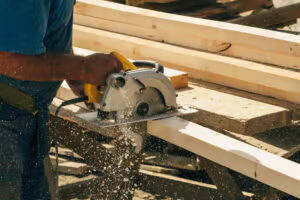
It’s not just new builds, either. Established homeowners in Boonsboro, Peakland, and similar Lynchburg neighborhoods are renovating older homes — and aging duct systems combined with active renovation work compound the contamination problem. A 20-year-old duct system that’s already carrying years of buildup doesn’t handle a kitchen gut or a bathroom remodel well. Whatever the project stirs up gets added to what was already there.
Not sure if your ducts need cleaning after your project? Call us at (434) 771-0977 — we’ll help you figure out where things stand.
What Skipping Duct Cleaning After a Project Does to Your Home’s Air
The EPA notes that remodeling and renovation have the potential to release indoor pollutants — and that dust and debris can deposit directly into ductwork and the air handler. [2] Sneezing, congestion, and aggravated asthma symptoms are the most common complaints we hear from homeowners after a project wraps or after moving into a new build.
VOC residue from painting, adhesives, and finishing work is worth paying attention to, especially in households with kids. A small study published in PLOS One found that indoor air pollutants — including VOCs from new building materials — aggravated atopic dermatitis symptoms in children, and that redecoration activities like painting and floor covering were associated with increased eczema risk. [3] That’s aggravation of existing conditions, not a diagnosis — but it’s a connection worth knowing about if your household has seen unexplained skin irritation since a project wrapped or since moving in.

The longer the system runs post-construction, the more that debris works its way into hard-to-reach sections of your duct runs. Addressing it early is a simpler job than addressing it months later.
What Professional Duct Cleaning Involves After Renovation or New Construction
Assessment Before Cleaning
A post-construction duct cleaning starts with an inspection — and it looks different from a standard cleaning job. Our technicians at Solutions Heating & Cooling are looking at where the return vents sit relative to where active work happened, because that determines how debris traveled through the system. A return vent in the same room as a drywall sanding job tells a very different story than one on the opposite end of the house.
The Cleaning Process
From there, it’s negative pressure equipment, brush agitation, and debris extraction. A high-powered vacuum creates negative pressure inside the duct system, pulling debris toward a collection point rather than just pushing it around. Brushes agitate the buildup that’s bonded to interior duct walls — the kind that doesn’t come loose from airflow alone. The debris gets extracted, not redistributed. That’s the difference between a cleaning and a cleaning that actually does something.

Schedule Your Post-Renovation Duct Assessment in Lynchburg
If your home has been through a renovation or you’ve recently moved into new construction in the Lynchburg area, call (434) 771-0977 and we can assess what your duct system is carrying and handle the cleaning from there. We’ve been serving Forest, Bedford County, and the surrounding communities for over a decade — this is exactly the kind of work we do.
Solutions Heating & Cooling 403 Fifth St, Unit 105, Lynchburg, VA 24504
What Lynchburg Homeowners Ask About Duct Cleaning After Renovation and New Construction
Should air ducts be cleaned once renovation work is finished?
Cleaning your air ducts after a renovation is something we strongly recommend. Renovation work is one of the most contaminating events a duct system can go through — drywall dust, insulation fibers, adhesive residue, and wood particulate all get pulled into return vents the moment your system runs. Your filter won’t catch what’s already coating your duct walls.
Why can’t my HVAC filter handle the dust left over from construction work?
Standard HVAC filters can’t handle construction dust because they’re rated for normal household particulate, not construction-grade debris. Even higher MERV-rated filters face the same limitation: by the time the filter catches anything, debris has already been circulating for weeks and coating your duct walls. Filters catch what’s airborne — they can’t address what’s already bonded inside your ductwork.
Is there a connection between construction dust, indoor air quality, and eczema in children?
Construction dust and VOCs from renovation work can affect children’s skin health. A study published in PLOS One found that VOCs from new building materials aggravated atopic dermatitis in children, and that painting and floor covering were associated with increased eczema risk. If your household has seen unexplained skin irritation since a project wrapped or after moving in, it’s worth taking seriously.
Are duct systems in newly built homes already contaminated before move-in?
Duct systems in newly built homes are frequently contaminated before move-in. New construction involves drywall, insulation, flooring, painting, and finishing — all happening over an extended timeline while the duct system sits exposed. That debris gets distributed throughout the system. We regularly clean post-construction duct systems in the Lynchburg, Forest, and Bedford County area for exactly this reason.
Resources
- https://wset.com/news/local/bedford-county-board-of-supervisors-approves-development-of-54-new-townhomes-amid-traffic-concerns-us-221-enterprise-drive-forest-virginia-february-2024
- https://www.epa.gov/indoor-air-quality-iaq/indoor-air-pollution-introduction-health-professionals
- https://journals.plos.org/plosone/article?id=10.1371/journal.pone.0119501