
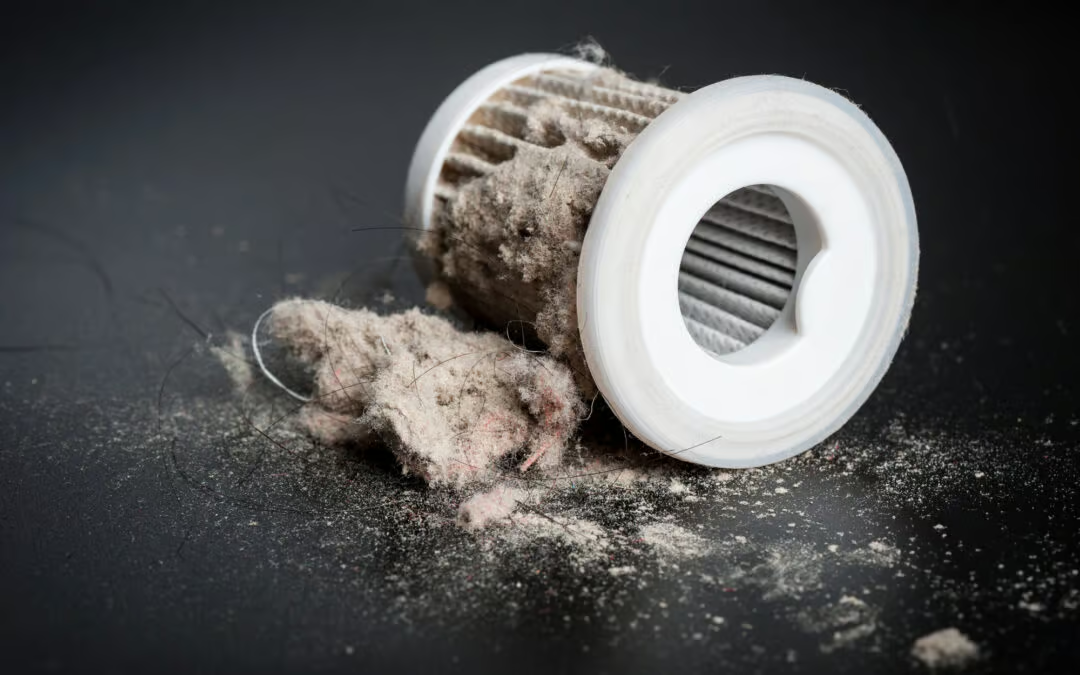
You changed the filter. You scheduled the tune-up. You did everything right. But if your home still feels stuffy, dusty, or just off — the problem may not be your equipment. It may be what’s been quietly building up inside your ductwork for years.
From dust mites to VOCs to mold spores, residential air ducts collect more than most homeowners expect. Here’s what’s actually in there, and why it matters.
What Is Commonly Found in Residential Air Ducts?
Residential air ducts commonly collect a range of contaminants over time, especially in homes with pets, older construction, or high seasonal humidity. The most frequently found include:
- Dust and dust mites — shed skin cells and the microscopic organisms that feed on them
- Mold spores — introduced by moisture and humidity inside the duct system
- Pet dander — microscopic protein particles from skin, fur, and saliva
- Volatile organic compounds (VOCs) — off-gassing from building materials and furnishings
- Bacteria and airborne pathogens — particularly in systems with standing moisture
- Construction debris — drywall dust, insulation fibers, and sawdust from renovations
Dust and Dust Mites
Dust buildup inside ductwork isn’t a cleanliness issue — it’s a mechanical one. Every time your system runs, it pulls air through the return vents, and particulate comes with it. Over time, that material settles on duct surfaces where no filter can reach.
Dust mites feed on shed skin cells and thrive in the warm, low-light environment inside ductwork. It’s not the mites themselves that trigger allergies and asthma — it’s their waste particles, which stay airborne and recirculate every time the system runs. According to the Asthma and Allergy Foundation of America (AAFA), eight out of ten people in the U.S. are exposed to dust mites. [1] Dust mites and mold spores often share the same environment inside a duct system — which brings us to the next one.
Mold Spores
Mold spores are present in virtually every home environment — they enter duct systems through normal air intake. The problem isn’t the spores themselves, it’s the conditions inside ductwork: dark, potentially humid, with organic debris available as a food source.
Virginia’s climate makes this worth paying attention to. Central Virginia summers regularly push humidity above 70%, which creates favorable conditions for mold growth inside cooling systems specifically. If your system runs without much humidity control, the inside of your ductwork can become a hospitable place for mold to take hold.
Pet Dander
Most people assume pet dander means pet hair. It doesn’t. Pet dander is microscopic protein particles shed from skin, saliva, and fur — small enough to stay suspended in air and get pulled directly into your return vents.
Once inside ductwork, dander accumulates and recirculates every time the system runs. The AAFA reports that six out of ten Americans are exposed to cat or dog dander. If you’ve moved into a home with an unknown pet history from previous owners, there’s a good chance some of that history is still living in the ducts. Pet dander and VOCs often travel the same path through your system — which leads us to a contaminant that works a little differently than the rest.

Volatile Organic Compounds (VOCs)
VOCs are the outlier in this list — they’re chemical, not biological. Paint, adhesives, flooring, cleaning products, and new furnishings all release chemical vapors into your home’s air. EPA research found VOC levels to be 2 to 5 times higher inside homes than outside, regardless of rural or urban location. [2]
Your ductwork doesn’t generate VOCs, but it distributes them efficiently throughout every room. Off-gassing tends to be highest in newer homes or recently renovated spaces — something that maps directly to both homeowner avatars.
Bacteria and Airborne Pathogens
Bacteria thrive where moisture is present. Drain pans, cooling coils, and duct surfaces with condensation are the primary entry points. The EPA notes that contaminated central air handling systems can become breeding grounds for biological contaminants and then distribute them throughout the home. [3]
For established homeowners, aging systems with declining efficiency may also have declining air hygiene. For newer homeowners, an inherited system with an unknown maintenance history is worth having looked at. Construction debris is the last contaminant on this list — and probably the most overlooked.
Construction Debris
Drywall dust, insulation fibers, and sawdust enter duct systems during original construction or home renovation — and in many cases, systems are never properly cleaned afterward. Builders move on. Debris stays behind.

If you’ve moved into a newer home or recently had renovation work done, there’s a reasonable chance some of that material is still sitting in your ducts, recirculating every time the system runs. It’s not dramatic, but it is worth knowing — and it’s exactly the kind of thing a professional duct inspection can identify and address.
What the EPA Says About Your Indoor Air According to the EPA, Americans spend about 90% of their time indoors — and indoor air can be 2 to 5 times more polluted than outdoor air, regardless of where you live. That statistic holds whether you’re in a city or a rural area. The air inside your home matters, and your duct system plays a bigger role in that than most people realize.

If any of this sounds familiar — persistent dust, allergy flare-ups, or a system that hasn’t had a closer look in years — Solutions Heating & Cooling’s Lynchburg team can help. Call (434) 771-0977 to start a conversation. No pressure, just answers.
Solutions Heating & Cooling — Lynchburg 403 Fifth St, Unit 105, Lynchburg, VA 24504
FAQ: What’s Really Inside Your Air Ducts?
What kinds of contaminants build up inside home ductwork over time?
Home ductwork commonly collects dust and dust mites, mold spores, pet dander, volatile organic compounds (VOCs), bacteria, and construction debris. Systems in homes with pets, older construction, or high seasonal humidity tend to accumulate these contaminants faster. Each one enters through normal air intake and builds up on duct surfaces where standard filters can’t reach.
Is mold growth possible inside residential duct systems?
Mold growth inside duct systems is possible when the right conditions come together — darkness, humidity, and organic debris as a food source. In Central Virginia, where summer humidity regularly climbs above 70%, cooling systems are especially vulnerable. If your system runs without much humidity control, the inside of your ductwork can become a hospitable environment for mold to take hold.
Are volatile organic compound levels worse indoors than outdoors?
VOC levels inside homes are measurably worse than outdoors. EPA research found indoor VOC concentrations run 2 to 5 times higher than outside air— even in rural areas. Paint, flooring, adhesives, and new furnishings all release chemical vapors — and your ductwork distributes them efficiently throughout every room.
Does construction dust and debris remain in ductwork after building or remodeling work?
Construction debris — drywall dust, insulation fibers, and sawdust — enters duct systems during original construction or renovation, and in many cases systems are never properly cleaned afterward. Builders move on and the debris stays behind. If you’ve moved into a newer home or recently had renovation work done, that material may still be recirculating every time your system runs.
Resources
- https://aafa.org/allergies/prevent-allergies/control-indoor-allergens/
- https://www.epa.gov/indoor-air-quality-iaq/volatile-organic-compounds-impact-indoor-air-quality
- https://www.epa.gov/indoor-air-quality-iaq/biological-pollutants-impact-indoor-air-quality